
Arrest Warrant Lookup in Major County
What turns a complaint into an arrest warrant in Major County is a judge's signature, not a police decision. A prosecutor or complainant lays out a sworn account, a magistrate weighs it, and only then does the court authorize taking someone into custody. Oklahoma Title 22 §§22-161 through 22-171 spell out that magistrate authority and the verified complaint route. Once signed, the order lands in the District Court file kept by the Court Clerk. The Sheriff handles publishing and serving it. But the sheriff's website is not the complete legal record. The public Major County list also leaves out the affidavit and any probable-cause narrative behind the order.
Major County Complaint Process
Title 22 §22-171 sets the sequence. A complaint goes before a magistrate under oath or affirmation. If the magistrate is satisfied that the offense occurred, the statute directs that a warrant issue. Major County offers no public affidavit portal, no probable-cause packet, and no published warrant-number format. So the underlying file has to be requested. Ask the Court Clerk for the District Court case, and ask the Sheriff about law-enforcement list status. Expect the two answers to carry different fields, since each office records what its own process needs rather than one shared warrant record.
What a Major County Arrest Warrant Contains
The paper warrant often holds more than what the public Sheriff row displays. That web table lists a first name, last name, city, and state. Nothing else. Treat these as verification questions to ask the clerk, not as fields guaranteed to appear online in Major County.
| Warrant number | Not visible on the Sheriff row; ask for the official identifier, such as CASE-OR-WARRANT-ID. |
|---|---|
| Named subject | First and last name are visible, but a same-name match needs confirmation. |
| Charge or offense | Not shown in the public list; request the court's case information. |
| Issuing judge or court | Not shown in the public row and important for recall or bond questions. |
| Bond or bail | No current public amount or type schedule was located. |
| Date issued | Not shown online; ask the court or Sheriff records office. |
Major County List Versus Booking
The Major County Sheriff keeps warrants and custody in two separate systems. The Warrant List searches by name, city, and state. The Inmate Search deals with booking date and charges, and it updates on its own schedule. One screen cannot answer the other's question. An inmate result does not prove a particular warrant, and an empty inmate result does not clear one. For a public-list lead, use the warrant page. For District Court case confirmation, go to the Court Clerk. Save the jail or dispatch route for the custody question alone. The Sheriff's separate Inmate Search shows booking records, not warrant records, and mixing the two screens into one status answer is a mistake Major County callers should avoid.
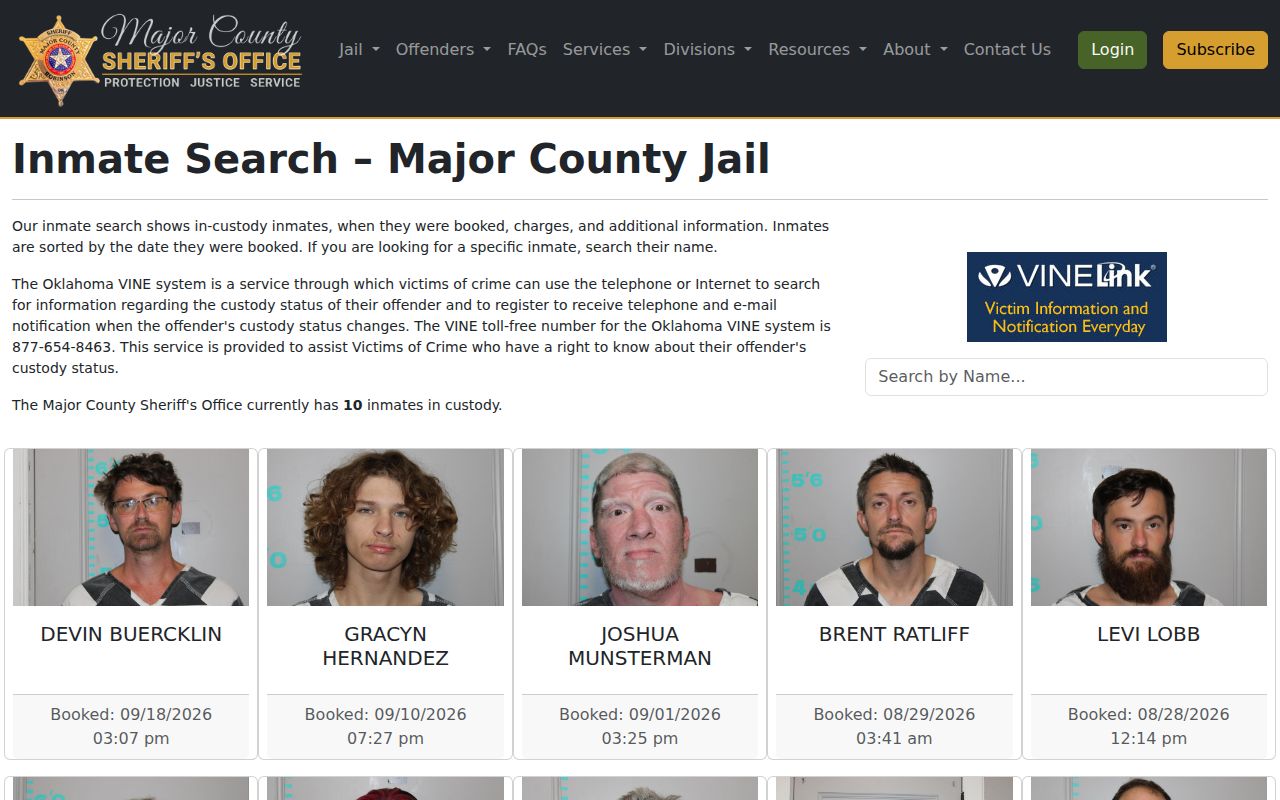
The custody screen exists here to mark the boundary between booking information and an arrest-warrant record in Major County.
How Major County Arrest Warrants Are Served
The Major County Sheriff is the county's documented service agency and the keeper of the public list. Fairview police handle city public-safety work, and Ringwood's police page directs warrant questions to the county Sheriff. No city marshal or county constable runs a separate warrant portal. Service usually happens through law-enforcement contact, though no published schedule predicts where or when. After custody, booking, court appearance, and bond questions all follow the court and jail process. A row on the county website tells you a warrant exists, not when an officer will act on it.
Major County Status Verification
Status on a list can lag reality. The Sheriff warns that entries change and asks people to call about mistakes or matters already resolved. A court record may show a recall, quash, bond, service return, or later appearance that has not yet reached the public page. So ask for the exact event and which office entered it. The Oklahoma Open Records Act can support a request for a kept warrant disposition, subject to exemptions and redactions. The Sheriff's Records Division takes those requests locally. It is a records route, though, not a live status certificate. Juvenile, sealed, victim-sensitive, and investigative material may stay protected even in Major County.
Arrest Warrant vs Summons vs Bench Warrant
Three documents, three jobs. An arrest warrant authorizes an arrest after a complaint and probable-cause process. A summons orders a person to appear without that arrest command. A bench warrant usually follows a missed required appearance in an existing case. The issuing court and the document's own language control which one applies. In Major County, treat the Sheriff list as a lead only. The Court Clerk or city court holds the actual file. The Sheriff may serve an order, but recall, quash, bond, and appearance terms belong to the issuing court.
| Feature | Arrest Warrant | Summons | Bench Warrant |
|---|---|---|---|
| What It Orders | Authorizes custody under the court's order. | Orders an appearance without being the same as an arrest order. | Compels a required appearance or compliance. |
| Basis | Complaint and probable-cause process. | Notice or citation from the court or city. | FTA, nonappearance, nonpayment, or another court trigger. |
| Who Issues It | A judge or magistrate. | The court or authorized issuing office. | The judge of the underlying case. |
| How to Respond | Verify, seek counsel, and ask about surrender or bond. | Appear as directed by the summons. | Ask the court about recall, appearance, bond, or quash. |
What to Do If There Is a Warrant for You
Call the Major County Sheriff at 580-227-4471 to learn which court issued the warrant. If it is a District Court case, the Court Clerk at 580-227-4690 handles the file. A lawyer can weigh a voluntary appearance, a licensed bondsman, bond, or a motion to recall or quash. No single path fits every warrant.
Important: Do not pay a caller or act on a name-only match. Verify the issuing court, current status, bond route, and safe next step through official sources.
The Major County Sheriff's walk-through notice covers only eligible active warrants. Its stated conditions require a licensed bondsman and a good-faith effort, with limits tied to the nature of the warrant, yet it names no amount or payment method. Call before you go. The OAG also warns that real officials never demand preemptive bail or cryptocurrency by phone, email, or mail.
Major County Federal Arrest Boundary
A clean result from the Major County Sheriff only speaks to county records. Federal warrants live in a different system. Major County sits in the Western District of Oklahoma, assigned to the Woodward Division, so federal questions go to the federal court, your counsel, the USMS, PACER, or RECAP. Even public federal docket access can hide sealed warrant materials. A county Court Clerk cannot certify a federal answer. The Most Wanted page is not a federal source either. Use official federal contacts, and never try to locate or confront anyone from a list.
Major County 2024 Warrant Terms
SB1660 took effect November 1, 2024, and CLEET's 2024 legal update explains how it amended the definitions of search, arrest, and bench warrants. One piece carved out warrants issued only for failure to pay certain court financial obligations, restitution aside. What a statute calls a thing, though, does not bind how a Major County docket labels an event. For a case-specific question, trust the Court Clerk and the current Title 22 text over a statewide summary. Legal terms in an update are no substitute for the exact court record.
Arrest-Warrant Source Check
Three doors help here. The Sheriff warrant list offers a public lead in Major County, the Sheriff contact route answers service questions, and the OSCN docket service covers a known public case. The Court Clerk or issuing judge still has the final word on status.