
The Major County Most Wanted Program
The Major County Sheriff runs the Most Wanted page as an official publication. It looks different from the agency's regular Warrant List. A Search Most Wanted box sits at the top, and a public disclaimer runs alongside it. The profiles also carry richer record labels than the plain warrant search returns. One thing to expect: the sheriff's current notice says the list is being updated and asks readers to check back later. So a missing name proves very little. For your own status, the issuing court or the sheriff's office, not a web page, gives the answer that counts.
Major County List Scope
Most Wanted is a subset, plain and simple. The sheriff's regular Warrant List takes a first or last name and returns first name, last name, city, and state from its published set. The Most Wanted side goes deeper, with labels like Race, Eye Color, Bond Amount, Sex, Hair Color, Last Known Location, Aliases, and Wanted For. Those fields show what the agency may publish, not a roster anyone should copy. The sheriff posts no reward amount, no selection rule, no archive, and no refresh schedule for the Major County list. The page itself warns that records may go stale as accounts and statuses change. A blank search result, in other words, is not proof that no warrant exists. Confirm with the sheriff or the issuing court instead. Read the list as an agency notice rather than a complete export of every Major County warrant. If your name is common, use the public fields only to spot a possible match. Then verify the record through the official channel before drawing any conclusion about a Major County warrant.
How the County Most Wanted and Warrant Roundup Lists Work
The Major County sheriff publishes no formal selection rule for Most Wanted. No roundup count, reward schedule, or update calendar appears either. What the agency does show is that the page is curated and currently being updated. A warrant status can shift after service, surrender, recall, payment, or another court event long before the public page catches up.
Note: A published profile is a snapshot. A change in court status can come before a web update, and absence from the curated page does not prove no warrant.
Major County Update Notice
The live Most Wanted page says it is being updated and to check back soon. That notice explains why results can shift between visits. The regular Warrant List carries a similar caveat: it may not reflect real-time updates. Neither page publishes a refresh schedule. When a Major County warrant question involves a possible match or an already-resolved record, call 580-227-4471. Note your search date privately, since pages change. No web page substitutes for confirmation from the court.
How to Report a Tip Safely
The sheriff's Submit Tip form asks for an incident date and the details you know. You can stay anonymous or allow contact. Name, phone, and email come into play only if you pick the contact option. Remember, this channel is for tips, not warrant-status requests, so Major County residents checking on a case need a different route.
- Use the Sheriff's Submit Tip form or the anonymous channel offered by the local law-enforcement program rather than a personal account.
- Give the location, time, description, and other useful details, and save any confirmation or tip number provided.
- Do not approach, follow, restrain, or detain anyone yourself. Let law enforcement decide how to respond.
- Call 911 for an emergency; a records or tip form is not a substitute for immediate emergency assistance.
Key Point: Report information to the Sheriff or local law enforcement, keep distance, and never attempt apprehension. Call 911 for an emergency rather than using a records form.
The official Submit Tip page shows the emergency warning and the anonymity choices Major County residents can pick, without any private person's profile appearing.
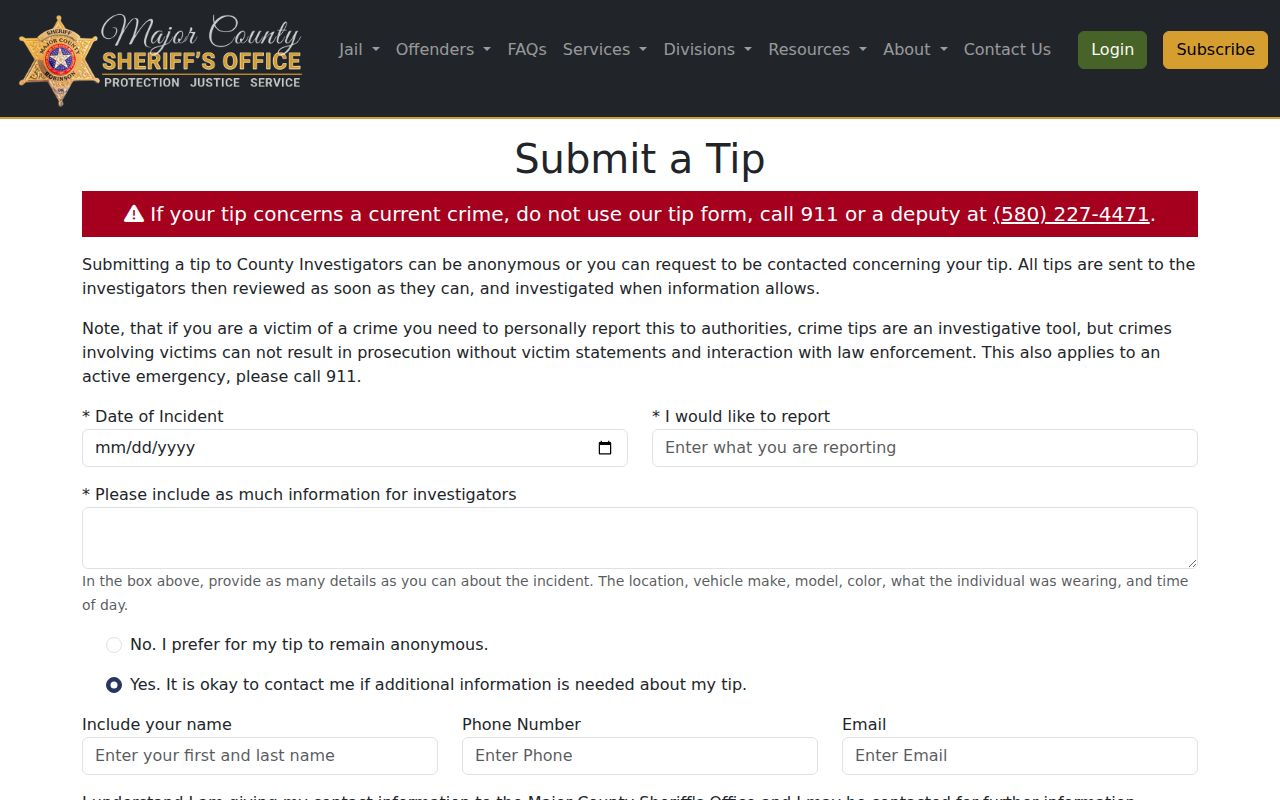
Use that form for what you know about an incident or a person. It is not for asking whether your own case carries a warrant. For that, take the Major County Sheriff or Court Clerk contact route.
Major County Most-Wanted Scam Check
Beware of preemptive bail scams. The Oklahoma Attorney General issued a warning in June 2025 about callers posing as officials. Real officers do not serve arrest warrants by phone, email, or mail, and they never demand cryptocurrency. A scammer may quote a genuine courthouse address or a plausible case detail and still be lying. Open the Major County Sheriff's official contact page yourself and call 580-227-4471. Skip any callback number or payment link the caller supplies. The same caution applies whenever someone leans on a public list to pressure you.
County Most Wanted vs an Active Warrant
A Major County Most Wanted profile is a curated notice. An active warrant is a court order, and it can sit entirely outside the featured list. Most active warrants never make a selected page. The sheriff's name search and the issuing court's docket answer different questions. Treat neither public page as a real-time legal certification of your status.
| Feature | County Most Wanted List | Active Warrant |
|---|---|---|
| Scope | Curated public-safety subset | Any unserved warrant that remains active |
| Who publishes it | Sheriff or participating public-safety program | Issuing court records and law-enforcement systems |
| Public visibility | Selected profile fields, if published | Name or case research only where the record is public |
| How to resolve | Confirm with counsel or the agency and arrange lawful compliance | Ask the court or counsel about surrender, bond, recall, or another remedy |
If You Believe You Are on a List
A profile that seems to match you is not the place to stop. Do not contact anyone named in it. Write down the displayed details and ask a lawyer to confirm the court and case. Then work through the lawyer or the sheriff's official number to discuss a safe surrender or bond process. The Major County Court Clerk can point you to the public court-record route. Staff cannot give legal advice, though, or promise that a record will be recalled.
Important: Confirm the identity and current status with counsel or the responsible office before appearing, paying, surrendering, or sharing personal information.
Major County Scam Warning
Scammers work the warrant angle hard in Major County. In June 2025 the Oklahoma Attorney General warned of preemptive-bail calls. A caller claims a warrant is out, then demands money, cryptocurrency, or a transfer to stop an arrest. A convincing name, case detail, or government address proves nothing. Hang up. Open the Sheriff's official contact page yourself and call 580-227-4471 directly. Skip any callback number left in a threatening message. A federal concern belongs with the federal court or your counsel, not a county list.
Major County Program Boundaries
Treat the Major County Most Wanted page for what it is. It is not a booking roster. It is not a complete active-warrant database, and it does not replace the Oklahoma State Courts Network. OSCN helps you pull up a case docket and case number. No statewide public database exists in Oklahoma that certifies every current warrant, so a clean search there settles less than people hope. Do not republish names or images from the page. When a fuller record matters, the Oklahoma Open Records Act offers a request route, though exemptions and redactions can apply. Juvenile records sit under separate protection in Title 10A, so read nothing into their absence here.